
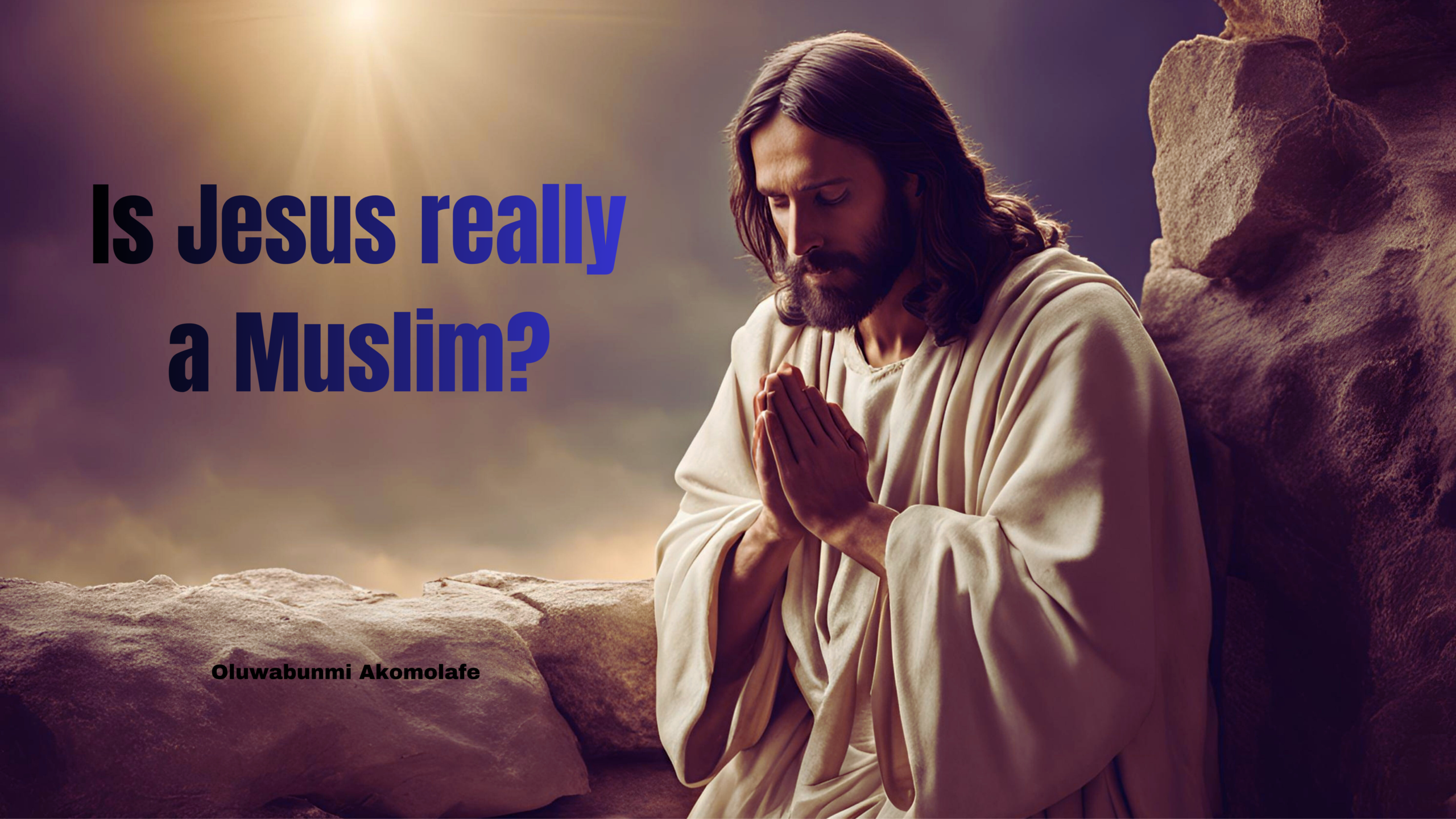
Claim: “Jesus is a Muslim, Abraham is a Muslim, Moses, David, and all the prophets are Muslims.”
Why?
Answer to Claim: Because Jesus prostrated to pray and said, “Peace be upon me.”
This is one of the most dangerous claims to make. Why?
A few things need to be noted before I proceed:
- One of the greatest gifts you can give yourself as a person is to read.
- When it comes to reading, it is very important to read a book in its literal meaning and at most if the writer is speaking figuratively that you understand in the context of the writer. I do not believe any book should be spiritualized, including the Bible.
- It is okay to be wrong in the presence of God and then accept correction, rather than arguing with God. Reasoning with God is a great practice but not arguing and calling God wrong.
- The Bible is a collection of 66 books written by about 40 authors over a period of approximately 1,600 years. You and I are not the original audience of the Bible, meaning the writers were not directly speaking to us; they all had their immediate audience.
Abraham was not a writer of any book in the Bible; Moses wrote about him. The direct audience of Moses was the Israelites, right? Also, the direct audience of Jesus was His disciples and the Jews—not you and me—however, His teachings have been passed down to us.
Hence, I say all this to emphasize that you understand what is written only when you understand why it was written and how it was conveyed to its original audience.
Let us now dive into the claim.
“And Abram believed the Lord, and the Lord counted him as righteous because of his faith.” Genesis 15:6 NLT
We see that Abraham believed God in this verse. How? Backtrack to the previous verses.
“You have given me no descendants of my own, so one of my servants will be my heir.” Then the Lord said to him, “No, your servant will not be your heir, for you will have a son of your own who will be your heir.” Then the Lord took Abram outside and said to him, “Look up into the sky and count the stars if you can. That’s how many descendants you will have!”” Genesis 15:3-5 NLT
Abraham believed what God said to him concerning the number of his descendants, even when he did not have any. This is faith. Therefore, the relationship between Abraham and God was faith-based, not religion-based.
Abraham was told in the earlier verses to leave his family and associations because of idolatry. God spoke to Abraham, and he believed. Faith, not religion.
We see the faith of Abraham expressed in his willingness to sacrifice his own son.
“Some time later, God tested Abraham’s faith. “Abraham!” God called. “Yes,” he replied. “Here I am.” “Take your son, your only son—yes, Isaac, whom you love so much—and go to the land of Moriah. Go and sacrifice him as a burnt offering on one of the mountains, which I will show you.” The next morning Abraham got up early. He saddled his donkey and took two of his servants with him, along with his son, Isaac. Then he chopped wood for a fire for a burnt offering and set out for the place God had told him about. Isaac turned to Abraham and said, “Father?” “Yes, my son?” Abraham replied. “We have the fire and the wood,” the boy said, “but where is the sheep for the burnt offering?” “God will provide a sheep for the burnt offering, my son,” Abraham answered. And they both walked on together.” Genesis 22:1-3, 7-8 NLT
- God tested Abraham’s faith, and we see that Abraham completely trusted God. In verse 8, Abraham believed God would provide a sheep for the burnt offering. Abraham knew Isaac was not the burnt offering, but that God would provide for Himself.
- Paul, in Romans 4:17, explained this by saying that Abraham believed God had the power to raise the dead. So while Abraham was going to sacrifice Isaac, he knew God could raise Isaac from the dead.
Abraham believed both that God would provide a sheep for the burnt offering, even when he had not seen anything in the physical (This is faith), and that God had the power of resurrection from the dead, according to Paul.
At the time of Abraham, there was no Judaism, Christianity, or Islam. The relationship between Abraham and God was faith in what God told him, even though there was no physical evidence at the time, but he chose to believe God.
Abraham had Faith not Religion
Moses
Moses was called to go to Egypt to release the Israelites after he himself had escaped from Egypt because he committed a crime. Moses led the children of Israel out of Egypt, about two million people (think of Ghana, lol). How would he lead these people without a constitution? Hence, God gave him the law, the Ten Commandments, and the covenant. When you study the relationship between Moses and God, it was also faith-based. God spoke to Moses at different times, and Moses believed God—faith. When Paul was explaining this in Galatians 3, he stated that the law was given to the Israelites to act as a custodian until faith.
“Before the way of faith in Christ was available to us, we were placed under guard by the law. We were kept in protective custody, so to speak, until the way of faith was revealed. Let me put it another way. The law was our guardian until Christ came; it protected us until we could be made right with God through faith. And now that the way of faith has come, we no longer need the law as our guardian.” Galatians 3:23-25 NLT
Paul is also half Jewish, so he associates himself as he explains his ideas to his audience.
Back to Moses: he worked with God by faith and prophesied concerning another prophet after him.
God had told Moses that He would raise a prophet among the people of Israel. Moses believed what God had told him, and now he was foretelling this to his people.
“Moses continued, ‘The Lord your God will raise up for you a prophet like me from among your fellow Israelites. You must listen to him.’ Then the Lord said to me, ‘What they have said is right. I will raise up a prophet like you from among their fellow Israelites. I will put my words in his mouth, and he will tell the people everything I command him.’”
Deuteronomy 18:15, 17–18 NLT
Moses himself did not have a religion but had faith in God concerning what God had told and shown him about the future. At the time of Moses, there was no religion. The people had the covenant and the law. At this time, the children of Israel had the law God gave them as their constitution.
Evidently, Moses never practiced any religion but believed God—faith.
David
At the time of David, there was already a nation called Israel whose constitution was given by God through Moses. David was a king in Israel, but before he became king, he was a shepherd boy who fought Goliath. He fought Goliath from a standpoint of faith. Faith cannot function without knowledge.
“David asked the soldiers standing nearby, “What will a man get for killing this Philistine and ending his defiance of Israel? Who is this pagan Philistine anyway, that he is allowed to defy the armies of the living God?”” 1 Samuel 17:26 NLT
“I have done this to both lions and bears, and I’ll do it to this pagan Philistine, too, for he has defied the armies of the living God! The Lord who rescued me from the claws of the lion and the bear will rescue me from this Philistine!” Saul finally consented. “All right, go ahead,” he said. “And may the Lord be with you!” David replied to the Philistine, “You come to me with sword, spear, and javelin, but I come to you in the name of the Lord of Heaven’s Armies—the God of the armies of Israel, whom you have defied.” 1 Samuel 17:36-37, 45 NLT
While all the armies of Israel were handicapped by fear, David took up the challenge by faith, leveraging the fact that God had rescued him in the past from lions and bears. This is what we call faith. Faith exists in the first place based on knowledge, not assumption.
In the time of David and Moses, even though they had the law, these men related with God by faith. Also note that at this time, there was nothing called Judaism.
See what David saw ahead:
“The Lord said to my Lord, “Sit in the place of honor at my right hand until I humble your enemies, making them a footstool under your feet.”” Psalms 110:1 NLT
David said, “I see my Lord said to my Lord.” What he said here was a mystery that was later unpacked in Peter’s teaching in Acts 2:34–35. Paul and the writer of Hebrews also referred to and explained this verse (Hebrews 1:13, 1 Corinthians 15:25, Hebrews 10:12–13).
From this study, it is obvious that neither Abraham, nor Moses, nor David were associated with being Christian, Muslim , or even Judaism. None of these categorizations existed in their time. They were all regarded as men of faith in Hebrews 11, and we also saw this ourselves as we briefly scanned through their lives.
Regarding the prophets, we see that none of them established any religion, nor did they author any sect. Instead, we see that the general reason God raised prophets in the Old Testament was to remind the people about the covenant He had made with them in the time of Moses. The prophets were not randomly preaching that people should serve God. The prophets who came later were reinforcing the law and covenant to the children of Israel, teaching them to turn away from evil and dumb idols, and to turn back to their God who brought them out of Egypt, pointing them back to the covenant He made with their fathers.
Most importantly, these prophets also prophesied about a new covenant, as seen in Ezekiel. Isaiah even predicted the birth of the Messiah and how He would be born. All of this still speaks to the same faith that Abraham, Moses, and others before them believed in. Different generations, same story.
In the time of the prophets, there was no Judaism.
Purpose of Old Testament prophets:
- To remind the people of the covenant God made with them through Moses
- To be part of the story God was telling by prophesying about the One who was to come from the lineage of David, not from Nigeria or America, lol.
How Judaism started: it began during the Babylonian exile (586 BC). This led to the destruction of the Temple, the cessation of sacrifices, and the scattering of Israel. This then raised the question, “How do we obey God without a Temple?” As a result, the people of Israel found the following solutions: preserving Scripture, teaching the law in communities, and interpreting the law for daily life. This is how and where Judaism was born.
Afterward, the Temple was rebuilt, but Judaism had already been formed, with synagogues, scribes, and teachers of the law, which later emerged into groups such as the Pharisees and Sadducees.
Jesus was born into the system of Judaism. Recall that Abraham, Moses, and all the prophets did not operate under Judaism, even though from the time of Moses there was a law and covenant from which Judaism later sprang.
Prophets like Ezekiel and Daniel, who are regarded as some of the later prophets, did not experience Judaism in its completed form; it was still in its formative phase, even though the Temple had already been destroyed at that time.
Is Jesus really a Muslim?
Jesus Christ was born into the Judaism system, so only Jesus had a religion in comparison to the people we have already discussed. When people make claims such as “Jesus is a Muslim,” they often quote Matthew 26:39.
“He went on a little farther and bowed with his face to the ground, praying, “My Father! If it is possible, let this cup of suffering be taken away from me. Yet I want your will to be done, not mine.”” Matthew 26:39 NLT
“He walked away, about a stone’s throw, and knelt down and prayed, “Father, if you are willing, please take this cup of suffering away from me. Yet I want your will to be done, not mine.”” Luke 22:41-42 NLT
In reading the account, Matthew said Jesus bowed with His face to the ground, while Luke said He knelt down.
One thing to note here is that when people experience the same event or hear the same story, they will document it differently even though it points to the same event. For example, if you send two people to represent you at a party and later ask them to report what happened, they will describe it differently even though it is the same story. One person might say the musician wore a red dress, while another might simply say the musician wore a dress. When you read both records, you are still able to understand that the musician wore a dress. However, one person was more descriptive. This is because we are all different.
There is no contradiction in this report; rather, we have more details when we combine both reports, which leads to the conclusion that there was a musician, the musician wore a dress, and the color was red.
Jesus knelt down and bowed down with His face on the ground, praying, “Father, if You are willing, please take this cup of suffering away from Me. Yet I want Your will to be done, not Mine.”
Bowing down to pray is a general posture of prayer that even pagan worshippers practice. Some cultures also bow to their kings, elders, and gods, but that does not make them Muslim.
If this verse is properly read, we observe that Jesus was praying to His Father, which contradicts Muslim beliefs.
Furthermore, Jesus was not even a Christian because, while He was on the earth, He had not yet established the new covenant that was prophesied about Him.
The word Christian was first used in Acts 11:26 in Antioch.
“When he found him, he brought him back to Antioch. Both of them stayed there with the church for a full year, teaching large crowds of people. (It was at Antioch that the believers were first called Christians.)”Acts of the Apostles 11:26 NLT
Christian is from a Greek word Christianos
Christos= Messiah/ Anointed One
ianos = belonging to or follower of
Christian literally means followers of Christ or those belonging to Christ.
Note that the believers did not create this name for themselves. If you read the book of Acts, you will observe that the believers were more focused on spreading the good news of what they had witnessed, that they were not concerned with forming a religion. The name Christian was given to them by others as a way of identifying those who followed Christ or belonged to Him.
Brief History of the word “Muslim”
The word Muslim first appeared in history in the Qur’an in the early 7th century, between AD 610 and 632, after the death of Jesus. This word was never used in the Bible, Jewish texts, Roman records, or pre-Islamic inscriptions.
Till now, I do not understand how the phrase “Jesus is a Muslim” can ever make sense, especially from a historical perspective.
Brief History of New Testament Documentation
The writings of Paul and all the apostles were written and circulated between AD 40 and AD 100. Remember, the Old Testament was already available before Jesus Christ. The New Testament was translated into Syriac between AD 100 and AD 150, and into Old Latin between AD 150 and AD 200, among other languages. Almost immediately after the apostles wrote these texts, they were translated into other languages.
Imagine that for all these years, there was no mention of Jesus being a Muslim simply because He bowed to pray.
Is there anything called Last Prophet?
Even within Christianity, Jesus was never regarded as the last prophet; there were prophets in the church.
“During this time some prophets traveled from Jerusalem to Antioch. One of them named Agabus stood up in one of the meetings and predicted by the Spirit that a great famine was coming upon the entire Roman world. (This was fulfilled during the reign of Claudius.) So the believers in Antioch decided to send relief to the brothers and sisters in Judea, everyone giving as much as they could. This they did, entrusting their gifts to Barnabas and Saul to take to the elders of the church in Jerusalem.” Acts of the Apostles 11:27-30 NLT
Prophet Agabus prophesied about a great famine, and this famine happened. The prophecy led the church in Antioch to provide help for the church in Rome. Agabus could have used his prophetic gift to start a religion if he wanted to. Also, Prophet Agabus gave another prophecy in Acts 21:9–11 about how Paul would be bound and imprisoned, and it happened exactly as he said.
We still have prophets today in the church. I even have a prophet friend, so being a prophet did not end with anyone. None of the prophets of the Old or New Testament started any religion. It is well.
This is why I said that claiming “Jesus is a Muslim, Abraham is a Muslim, Moses, David, and all the prophets are Muslims” is a dangerous claim to make.
The spirit behind this statement is disobedience.
The spirit behind it will deceive people who will never go back to read and cross-check.
Hey!!! Hell is very real, and hell is for those who reject God. Love will still watch people who insist on their choices. God, who is love, desires salvation for everyone, but He will not force it on anyone. God is a lover who desires two-sided love.
For those who say that because God is love, no one would go to hell, they are mistaken.
If you reject His method of salvation, then there is no other way to be saved.
This is why I desire all my friends to know this sweet and kind God.
Please read and research for yourself. Eh!! Your eternity should be so precious to you that you can go before God, regardless of your religion, and say, “God, please show Yourself to me.” Trust me, God will grant your request.
I did this myself. I am not a Christian because I was born one. I also had to pray that God would reveal the truth to me, and then I did my due diligence in studying.
One wrong attitude you can have toward any study material is to already have in mind what you want the writer to say, if so then go and write your own book.
Recommendations
Acts 7:1–53 – Stephen’s Preaching
Hebrews 11 (entire chapter) – Faith, not religion.
Acts 13:16–41 – Paul’s synagogue sermon from Abraham to Christ.
Abraham and faith (Paul & Hebrews)
- Genesis 15:1–6 – Abraham believed God; righteousness credited by faith.
- Romans 4:1–25 – Faith before law; resurrection faith emphasized.
- Galatians 3:6–29 – Promise precedes law; Christ is the Seed.
- Hebrews 11:8–19 – Abraham’s faith, including resurrection belief.
Moses pointing to Christ
- Deuteronomy 18:15–19 – Prophet like Moses.
- Acts 3:22–26 – Peter applies Deut. 18 to Jesus.
- John 5:45–47 – Moses wrote about Christ.
David seeing ahead
- Psalms 110:1 – “My Lord said to my Lord.”
- Acts 2:29–36 – Peter explains David’s prophecy.
- Hebrews 1:13; 10:12–13
- 1 Corinthians 15:25
Prophets and the New Covenant
- Jeremiah 31:31–34 – New Covenant promised.
- Ezekiel 36:26–27 – New heart and Spirit.
- Isaiah 7:14; 9:6–7; 53 – Messiah foretold.
- Luke 24:25–27, 44 – Jesus explains Moses, Prophets, Psalms.